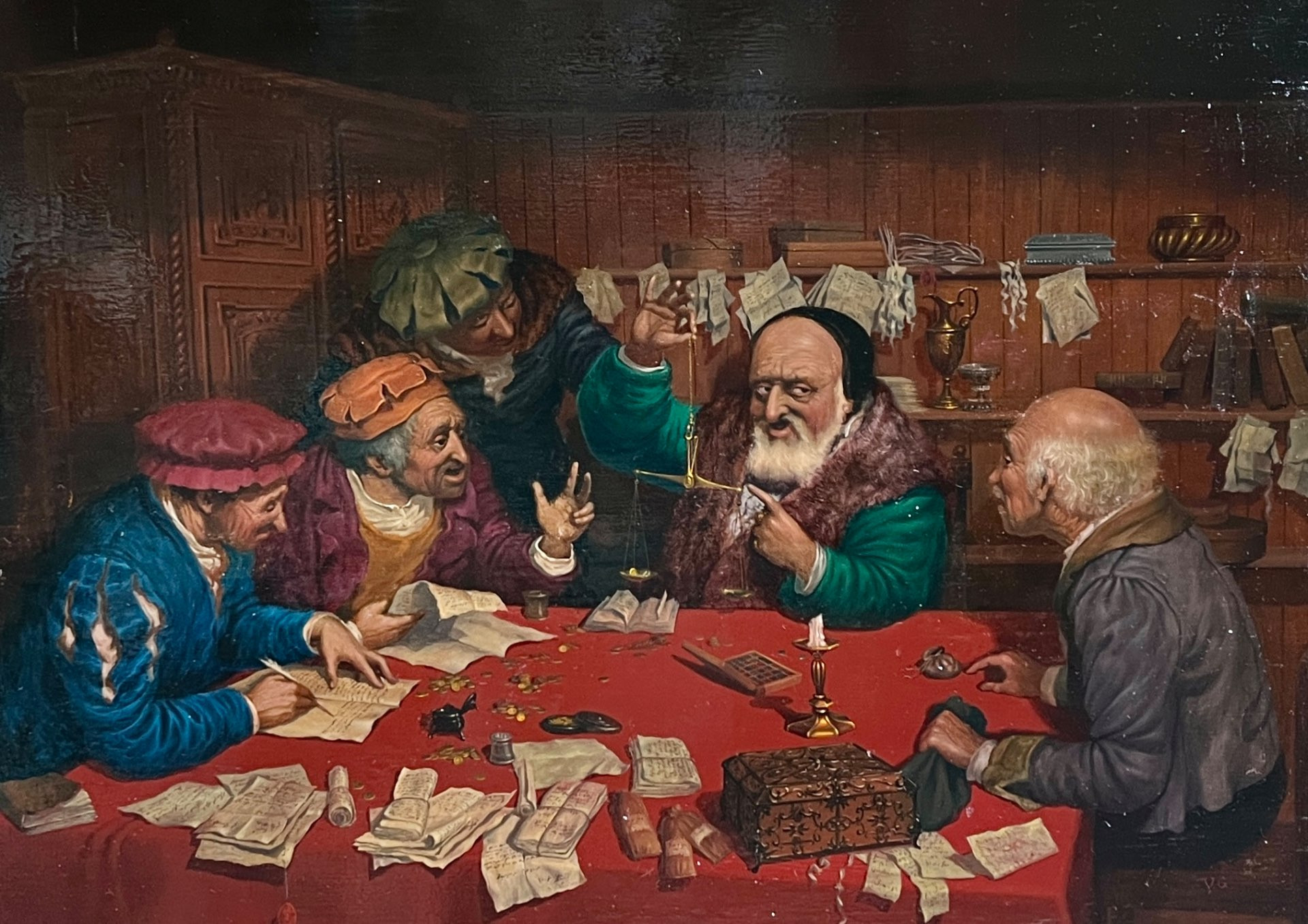
Vida, Gábor Merchants at the table (Haggling)


Current auction
In case of questions please ask:
Details
Description
The white-bearded merchant holds up a balance and points to its beam. The man opposite him is already raising a hand to object. On the left, one man writes with a quill while another leans forward over the speaker’s shoulder. At the right-hand end of the table, an older man follows the negotiations, his purse still in his hand. Vida Gábor captures the moment when the balance is meant to settle the deal, though everyone at the table has already done his own sums.
Vida was born in Budapest in 1937 and died in Telki in 2007. He began his career as a musician. His mother, Aranka Bacsó, was an opera singer, and his stepfather, the flautist József Kolsovszky, introduced him to the instrument at an early age. At ten, he was admitted to Budapest’s Liszt Academy of Music. In 1956 he joined the Budapest Philharmonic Society Orchestra, which was closely associated with the opera house, and became its principal flautist in 1959. He had already begun painting in his youth, teaching himself watercolour and oil painting. His early views of Budapest gave way to narrative interiors in which workshops, shops and people at work became recurring subjects.
In works such as The Apothecary, In the Antique Shop and In the Woodcarver’s Workshop, Vida uses the objects his figures handle to tell us something about them. His own interest in goldsmithing and repairing mechanical watches is reflected in his attention to tools and materials. In Merchants in Conversation, the objects help tell the story. The quill records what is still being disputed, the balance is meant to settle the matter, and the purse stays in its owner’s hand for the time being. Against the red tablecloth, glints of metal and the pale edges of the papers stand out. Such subtle shifts in tone are characteristic of Vida’s technique, in which he built up colour through several transparent layers.
The scene recalls sixteenth-century Flemish genre painting. The small balance brings to mind Quinten Massys’s The Money Changer and His Wife of 1514 in the Louvre. The arrangement around the table, with a clerk writing on the left and a man holding a purse on the right, has a striking parallel in Marinus van Reymerswaele’s An Advocate of 1542 in Munich’s Alte Pinakothek. Vida turns this pictorial tradition into a comedy of bargaining. The humour lies in the looks and gestures of the five men, who have the same balance before them and yet seem to draw quite different conclusions.