Vastagh, György jun. Beduin Camel driver
Current auction
In case of questions please ask:
Details
Description
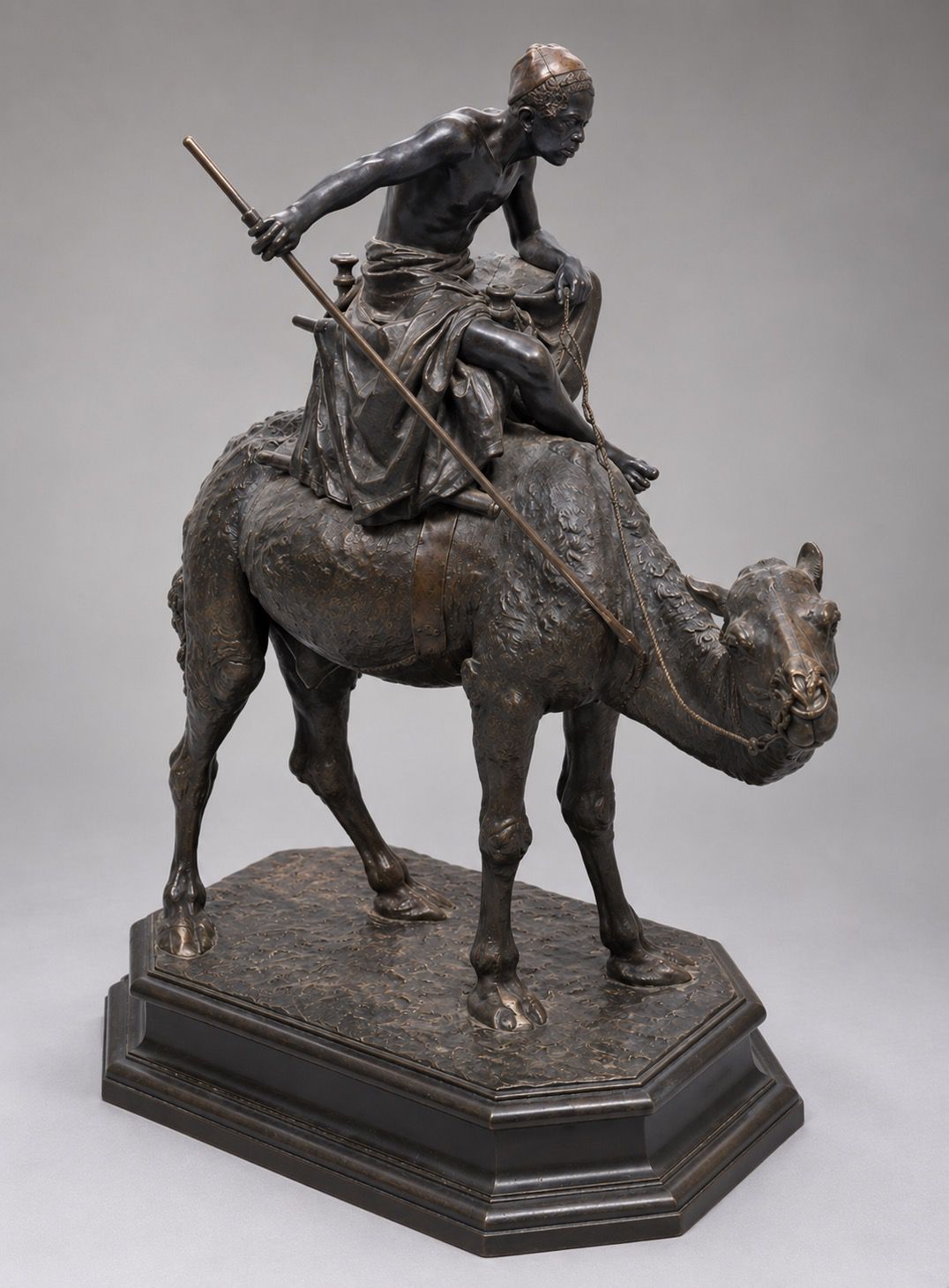
György Vastagh the Younger was one of the leading figures in Hungarian animal sculpture. His Camel Driver, shown under the title Tevehajcsár at the 1893 Budapest Winter Exhibition, brought him early recognition. The sculpture won the Count Tibor Károlyi Prize, and Emperor Franz Joseph I acquired the example shown at the exhibition. The imperial purchase marked an early success for the sculptor, whose animal sculptures would earn him a gold medal at the Paris Exposition a few years later.
North African subjects had caught Vastagh’s interest before he travelled to Algeria and Tunisia. In 1898, a state scholarship enabled him to spend four months there. He joined his elder brother Géza, a painter who shared his interest in depicting animals. During the visit, Vastagh made portrait studies and modelled another camel. Camel Driver shows how early the relationship between human and animal became a theme in his sculpture. He later returned to it in his celebrated Csikós at Buda Castle.
Vastagh’s standing as an animal sculptor rests on his ability to capture the individual character of his subjects. He rendered their anatomy with the same precision as their posture and movement. For the 1896 Hungarian Millennium Exhibition, he created an extensive series of animal sculptures, many of which are now in the fine art collection of the Hungarian Museum of Agriculture (Magyar Mezőgazdasági Múzeum) in Budapest. The museum brought together nearly sixty of his animal sculptures for a commemorative exhibition in 2008 and honoured his work again in 2018, on the 150th anniversary of his birth.
The example offered here is an electrotype with a bronze patina. In this process, an electric current deposits metal, usually copper, onto a conductive mould. The resulting metal layer reproduces even fine details of the modelling. Patination gives the surface its bronze tone. By around 1900, electrotyping was an established technique in specialist workshops. It offered an alternative to bronze casting, particularly for small sculptures, and allowed the details of the model to be faithfully reproduced in metal.