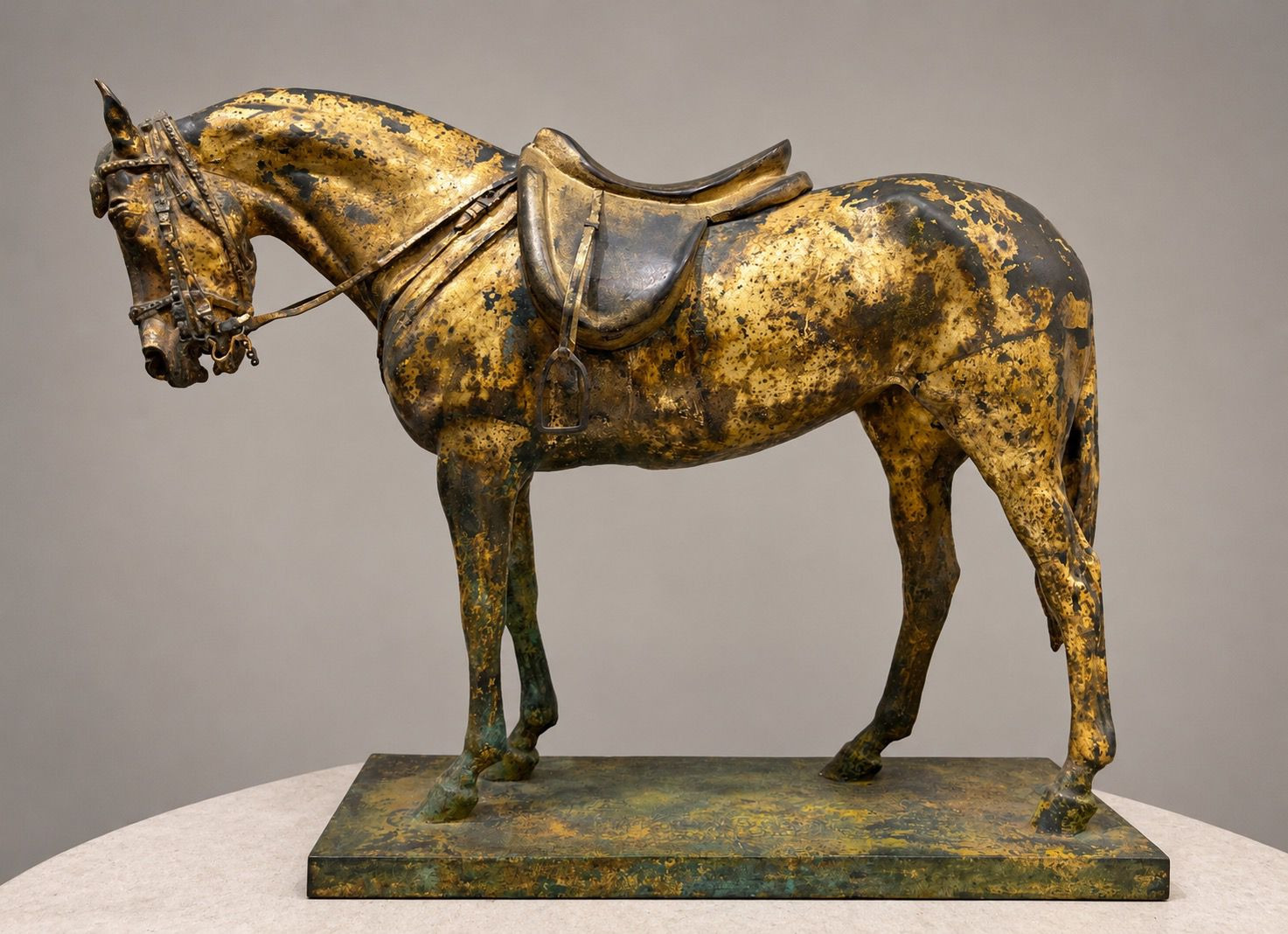
Vastagh, György jun. Saddeled Horse
Current auction
In case of questions please ask:
Details
Description
György Vastagh the Younger (1868–1946) ranks among Hungary’s foremost animal sculptors. After studying in Munich, he met the French animal sculptor Emmanuel Frémiet in Paris in 1893. A defining commission came with the 1896 National Millennium Exhibition in Budapest. For the Ministry of Agriculture, Vastagh produced fifty painted plaster sculptures at quarter scale, including portraits of breeding horses. At the state studs of Bábolna, Kisbér and Mezőhegyes, he was able to observe his subjects at close quarters.
Many of Vastagh’s sculptures portray individual animals, some of them prizewinners. He captured each animal’s build and bearing as precisely as the distinctive traits of its breed. He studied equine anatomy, worked from photographs and recorded his subjects’ measurements in sketches. His portrait of Kincsem, the legendary Hungarian racehorse, shows how far he pursued this precision. For the sculpture commissioned in 1942 as a perpetual trophy, he was able to consult period photographs and measurements and study the mare’s surviving skeleton. His reputation extended well beyond Hungary. In the early 1930s, he and his son László modelled around fifty Egyptian domestic animals, including horses, for the Agricultural Museum in Cairo.
The sculptures made for the Millennium Exhibition rank among the most important works in the fine art collection of the Hungarian Museum of Agriculture (Magyar Mezőgazdasági Múzeum) in Budapest. Vastagh’s portraits of stallions that founded individual Nonius bloodlines and of prominent Arabian stallions from Bábolna also document the history of Hungarian horse breeding. The museum devoted an exhibition to his animal sculpture in 2008 and celebrated his work again in 2018, on the 150th anniversary of his birth. At the 1900 Paris Exposition, Vastagh had already won two gold medals, one for his small-scale animal sculptures and the other for a smaller version of Csikós. The monumental group, depicting a Hungarian horse herder restraining his horse, once again stands in front of the Royal Riding Hall at Buda Castle. It gave the Csikós Courtyard its name.
The present example of Saddled Horse (Nyergelt paripa) comes from France. The inscription “Budapest, 1930” on the base points to a casting made in Budapest in 1930. Examples of this model in bronze with a gold-toned finish rarely appear at auction.