Mácsai István Woman in the red dress (Hommage a Giorgione)



Current auction
In case of questions please ask:
Details
Description
Lady in a Red Dress (Hommage á Giorgione)
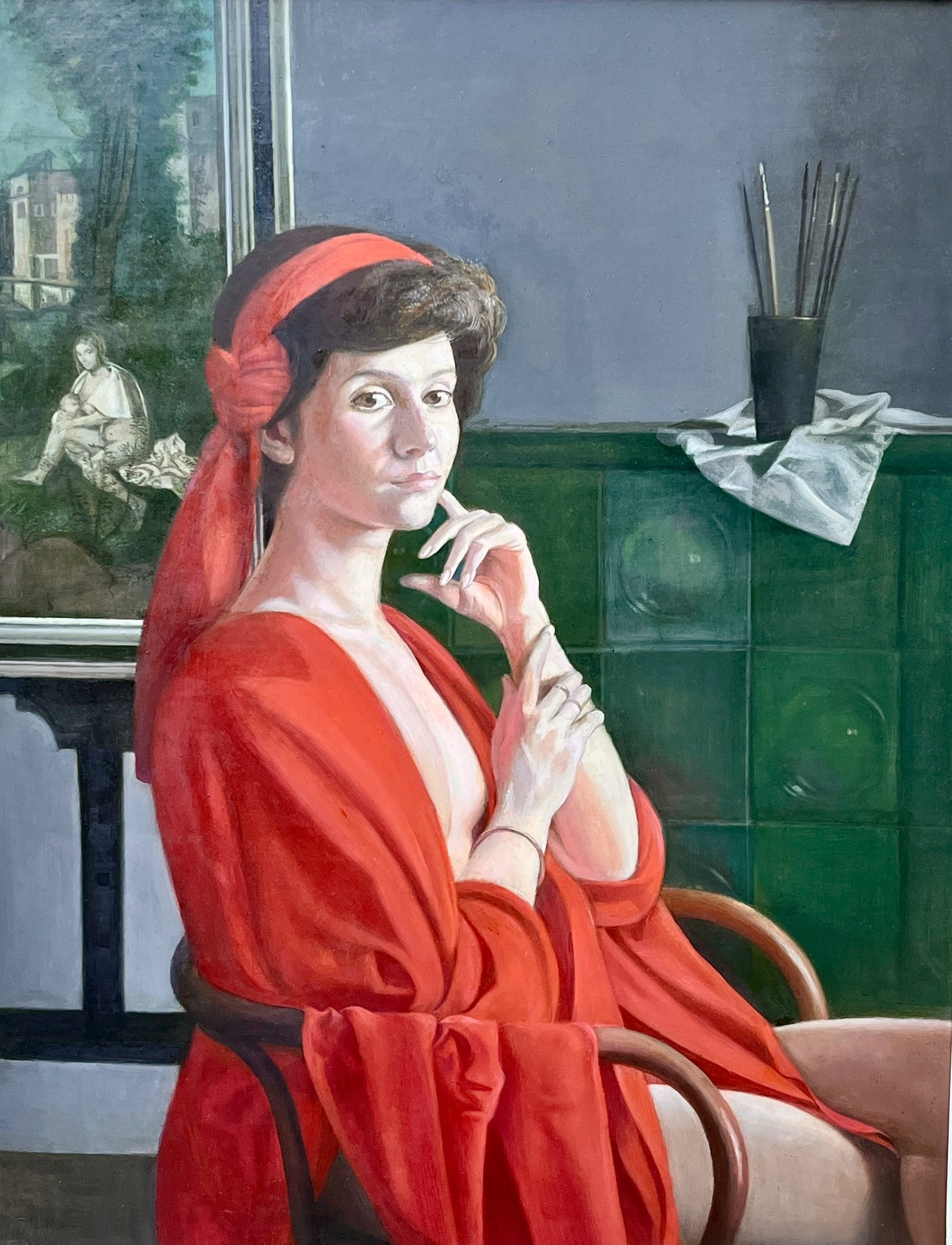
MÁCSAI István’s painting Lady in a Red Dress (Hommage á Giorgione) is a particularly remarkable and previously unknown work within the artist’s oeuvre. At first glance, it appears as an elegant and intimate female portrait: a young woman seated in an armchair, dressed in a vivid red garment and headscarf, looks directly at the viewer. Her delicately modelled facial features, carefully arranged hands and restrained yet assured presence exemplify the characteristic strengths of Mácsai’s realist portraiture.
Yet the composition goes far beyond conventional portraiture. In the left background, a picture-within-a-picture alludes to one of the most enigmatic works of the Venetian Renaissance: GIORGIONE’s La Tempesta (The Tempest), painted around 1506–1508. From this masterpiece, now in the Gallerie dell’Accademia in Venice, Mácsai chiefly evokes the nursing mother set within a landscape and her immediate surroundings. The image is therefore not an exact quotation, but a free, painterly reinterpretation of the Renaissance masterpiece.
The differing roles of the two female figures are especially intriguing. In GIORGIONE’s enigmatic landscape, the mother seems to become part of nature, while Mácsai’s protagonist appears as a modern, individual personality. Her gaze, however, seems to reflect something of the mystery and unresolved enigma of Giorgione’s painting, whose meaning remains unexplained. The Renaissance reference thus creates a subtle art-historical and psychological dialogue between two eras of female representation.
The emergence of this rare, previously unknown homage represents not only a significant discovery within Mácsai’s portrait painting, but also an important testament to his interest in the classical painting tradition and his deliberate artistic engagement with the great masters of the past.